

Creating an Environment Variable
- Go to environments (top right) and press No environment.
- If there are no environments, you will be prompted to create one.
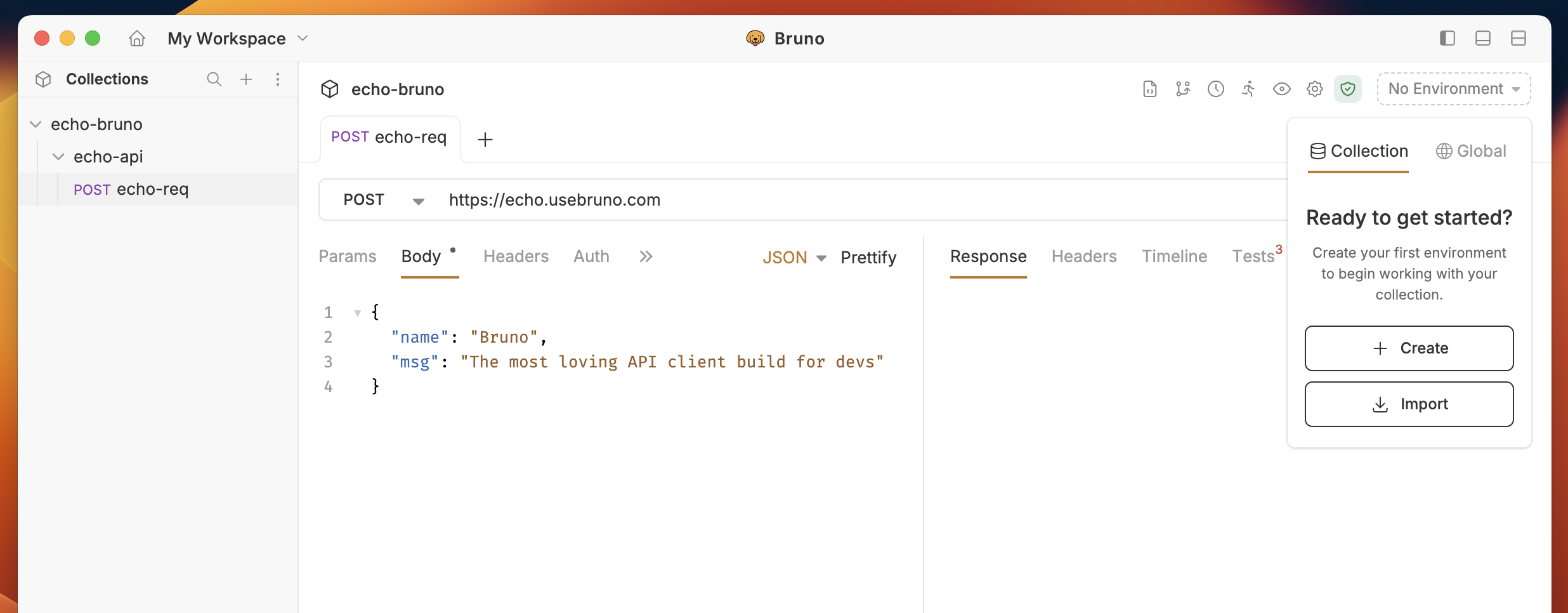
- Add your variable name, value, and an optional description for what the variable represents.
- Save your changes.
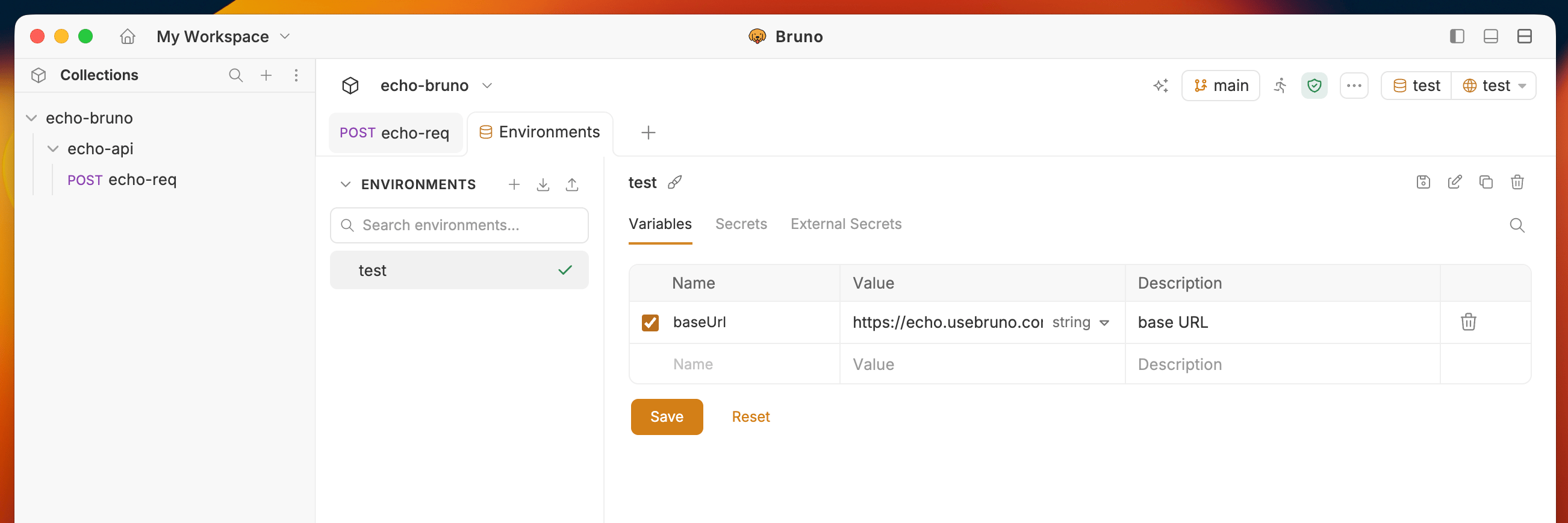
Using an Environment Variable
Just like other variables you can use the{{varName}} syntax to use an environment variable in a request. On the top-right, you can see which environment you are currently using and select a different one.
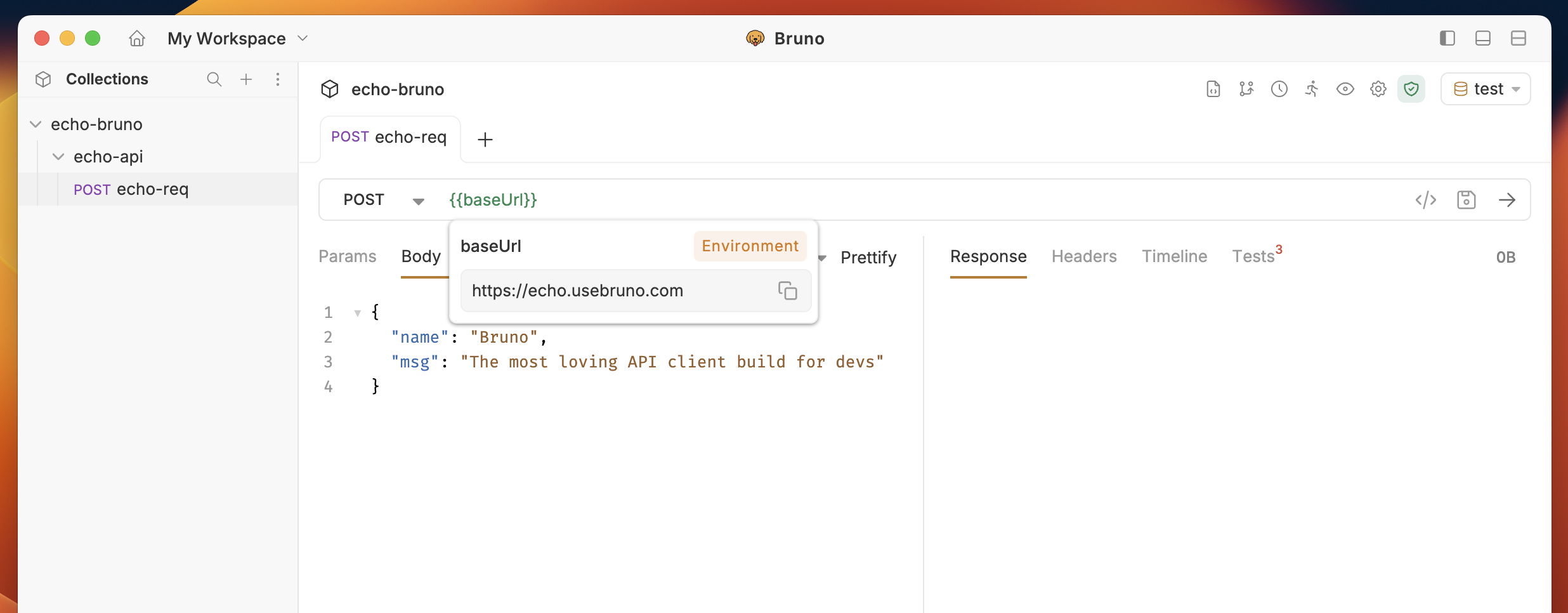
Inherit from a parent environment
Use inheritance when DEV, STG, PRD, or role-based environments share most values. Define the common variables once on a parent, then override only what differs on the child. An environment can inherit from one parent of the same scope (collection environments inherit collection environments; global environments inherit global environments). Chains are allowed:STG-GW → STG → base. The child’s own values always win.
Inside the environment tier, Bruno merges furthest ancestor → ancestors → direct parent → active environment. Other Bruno scopes are unchanged: global, collection, resolved environment, folder, request, runtime, prompt, process.env, secrets.
Set a parent
- Open the environment.
- In the header, open Inherits from and pick one parent.
- Save.
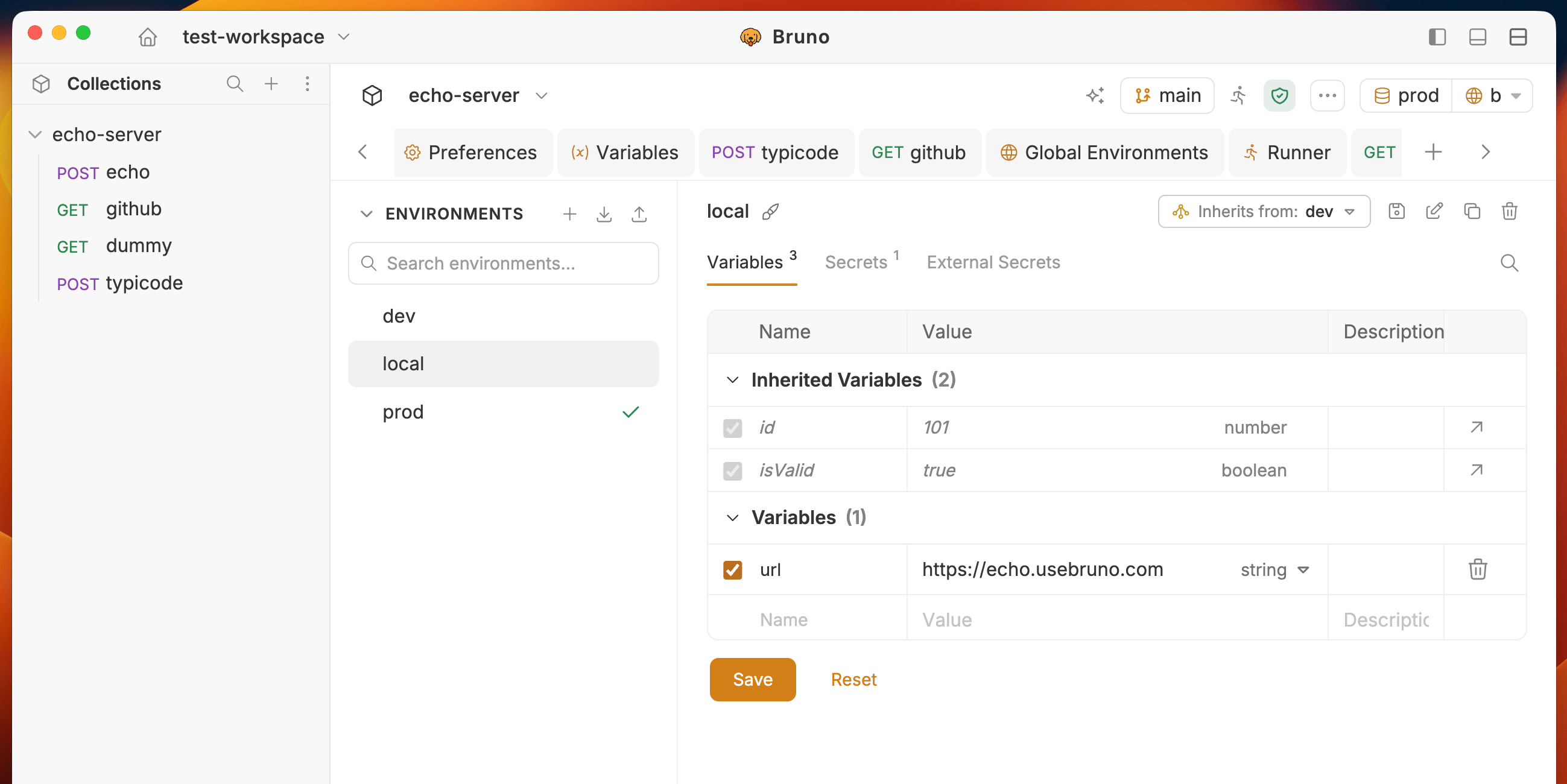
How values are merged
Flattening happens before interpolation and merges raw values only.{{variable}} is then resolved once against the full scope. That means a parent value can reference a variable defined on the child.
The merged set is computed at read time. It is never written back to disk. The extends field on the environment file is the only persistence. Its value is the parent environment name.
Searching environment variables
When working with a large number of environment variables, you can use the search feature to quickly find specific variables.- Open your environment settings.
- Click the search icon in the environment details panel.
- Type your query to filter variables by name or value.
The search feature is also available for global environment variables.
Default environment
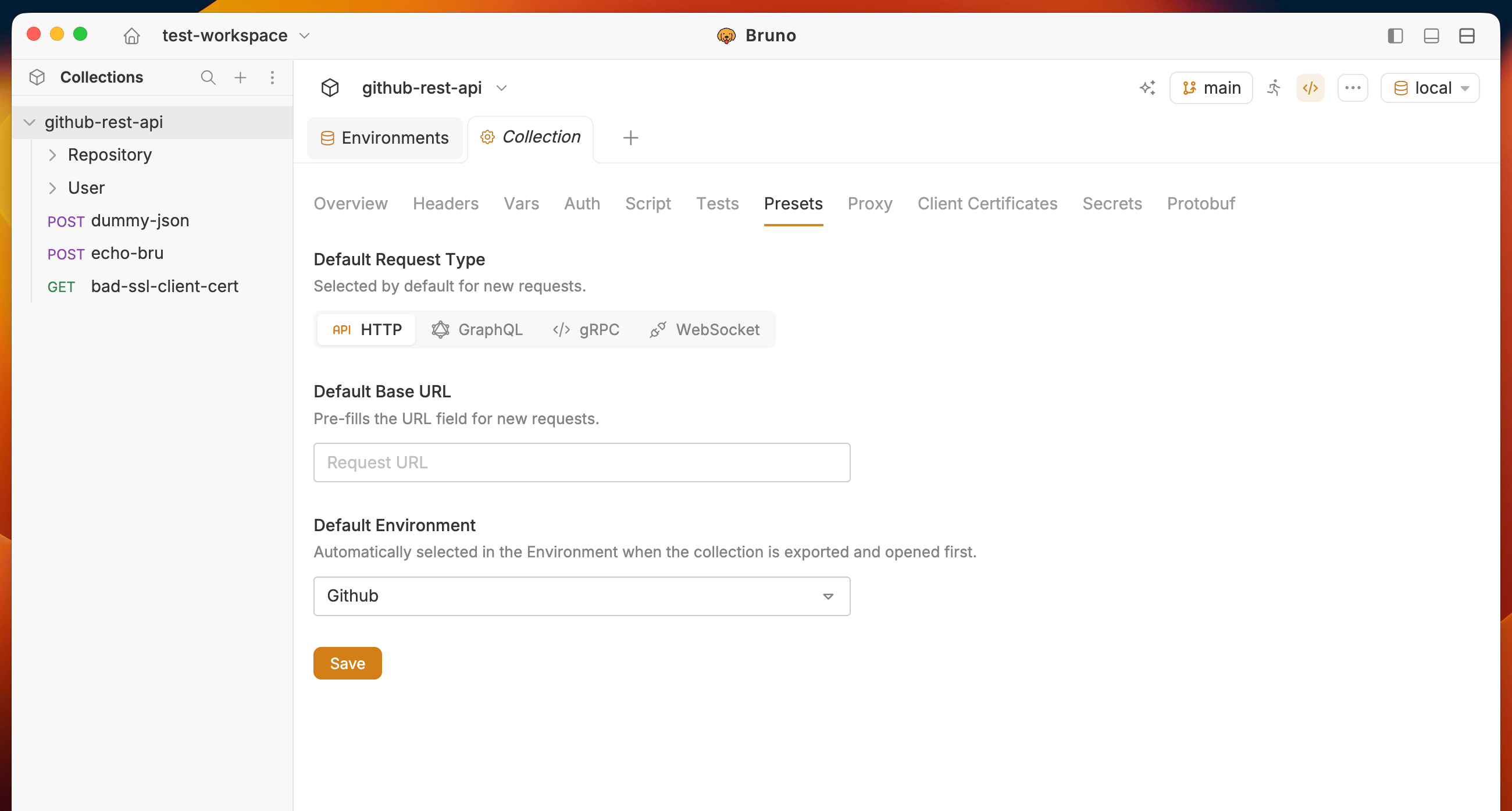
You can set a default environment for a collection so teammates and new sessions start with the right environment selected, without picking it manually every time. The default is stored in the collection > Presets and travels with the collection when you share, export, or import it.Set a default environment
- Go to Collection > Presets tab.
- Select the collection environment you want as the default
- Click Save button.
How the default is applied
The default environment is shareable with the collection. Setting it updates collection config (
bruno.json or OpenCollection YAML), not only your local UI state.Persistence and export
The default environment is persisted in the collection configuration and included when you export the collection:- Bruno native - stored in
bruno.json - OpenCollection YAML - stored in
opencollection.yml
Example config
After you set Local as the default, the collection config includes that choice. Exact field placement depends on format:- Bru Collections
- OpenCollection YAML
bruno.json
Using the ./environment directory
Environment variables are synced with the/environments directory inside your collection. You can also create and manage environments there.
Each environment is saved in a <environment-name>.bru file or a .yml file depending on the format in use.
BRU format (local.bru)
@description before a variable to document what it represents. Descriptions are optional, always go on the line immediately before the variable, and support multiline text using triple quotes (''').
YAML format (production.yml)
description field is optional. Use the block scalar |- for multiline descriptions to preserve line breaks. A variable with an empty name and value is treated as an orphaned description row in the UI.
For information on importing and exporting environment variables, see the Import/Export Environments guide.